Just like plants, we don’t grow all at once. Growth is not a single moment but a journey—quiet, patient, and unfolding over time.
We grow through learning, through trying, and through moments when things don’t go as planned. Even our mistakes have purpose; they teach us, shape us, and guide us forward. Nothing we experience is wasted when we choose to learn from it.
Plants listen to their environment. They turn toward the light, stretch their roots toward water, and adjust when conditions change. They endure storms, lean with the wind, and still continue to grow. Each season leaves its mark, making them stronger and more resilient.
In the same way, people grow through experience. When we stay curious, ask questions, and open ourselves to learning, we build strong foundations within ourselves. Learning helps us adapt, discover our strengths, and believe in our ability to grow beyond our limits.
The more we learn, the deeper our roots grow—anchoring us with confidence, wisdom, and resilience. And with strong roots beneath us, we can rise through uncertainty, reach for new possibilities, and grow taller than we ever imagined.
We design educational resources that help tiny minds take root and grow into mighty oaks.
TO GROW, WE NEED TO LEARN
ROOTS
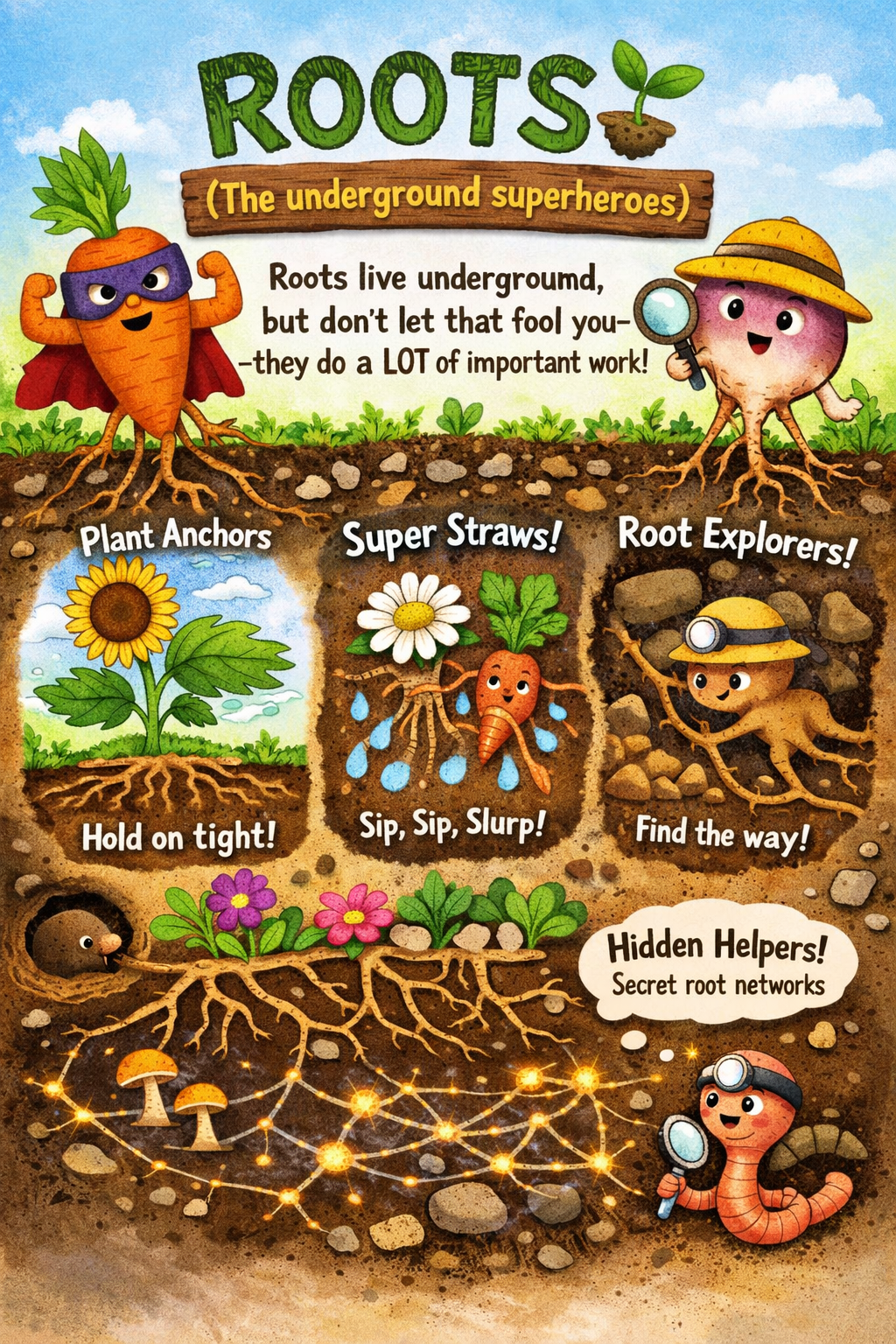
(The underground superheroes)
Roots live underground, but don’t let that fool you—they do a lot of important work.
First, roots act like plant anchors. They grab onto the soil and hold plants steady when wind blows or rain pours. Without roots, plants would tip, tumble, and fall over.
Roots are also super straws. They drink up water and nutrients from the soil and send them up to the rest of the plant. Every leaf, flower, and stem depends on roots to stay healthy.
Roots are great explorers. They twist, turn, stretch, and squeeze their way around rocks and through soil, always searching for what the plant needs. When they hit an obstacle, they don’t give up—they find another way.
And here’s something really cool: roots often team up. Underground, many plants share nutrients and send messages through hidden networks in the soil. Plants that look separate above ground may actually be connected below it!
Roots remind us that the strongest parts aren’t always the ones we can see. Before anything grows tall, blooms bright, or reaches the sky, it has to grow deep.
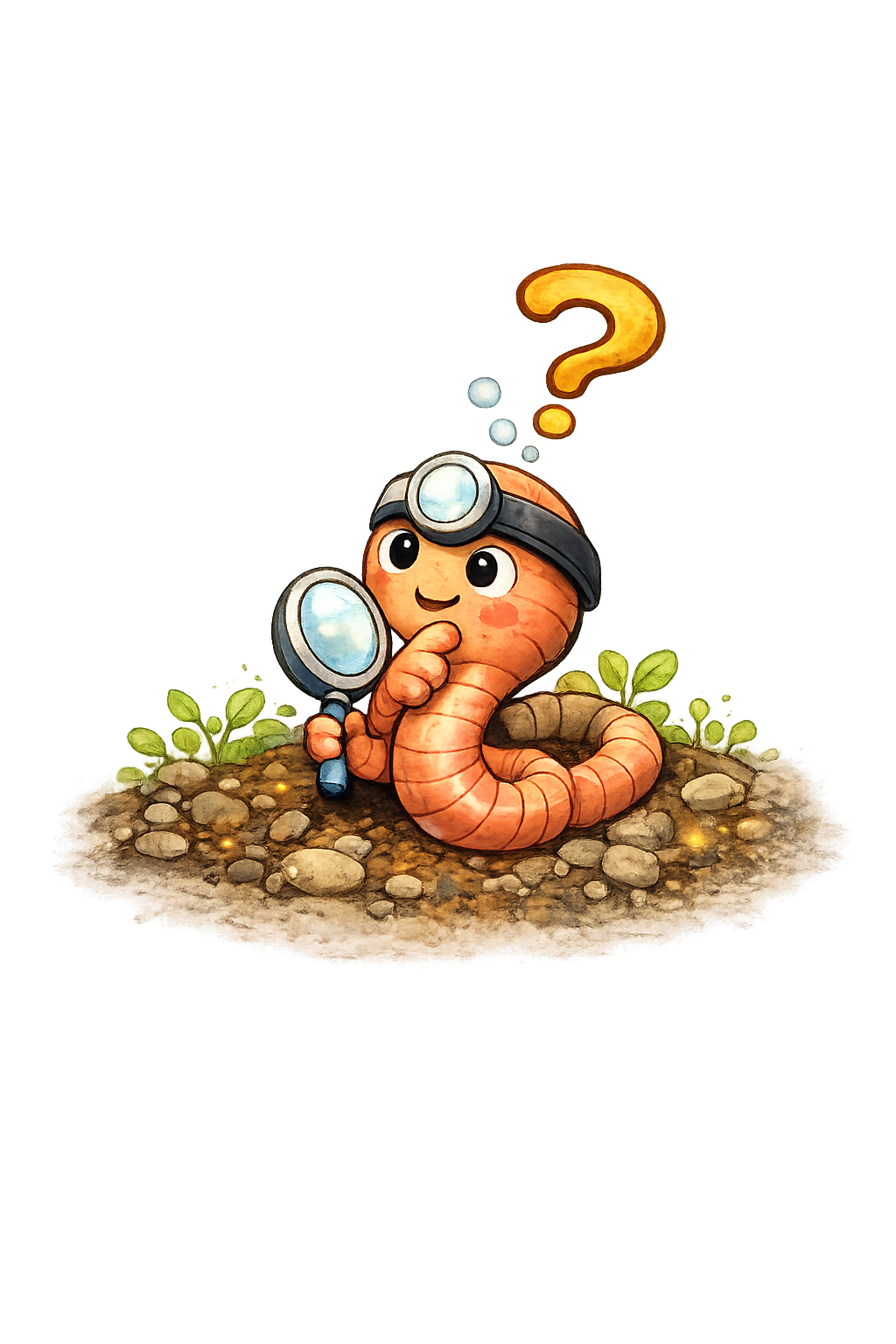
Quick Think
If you were a root, what would you be searching for?
TREES
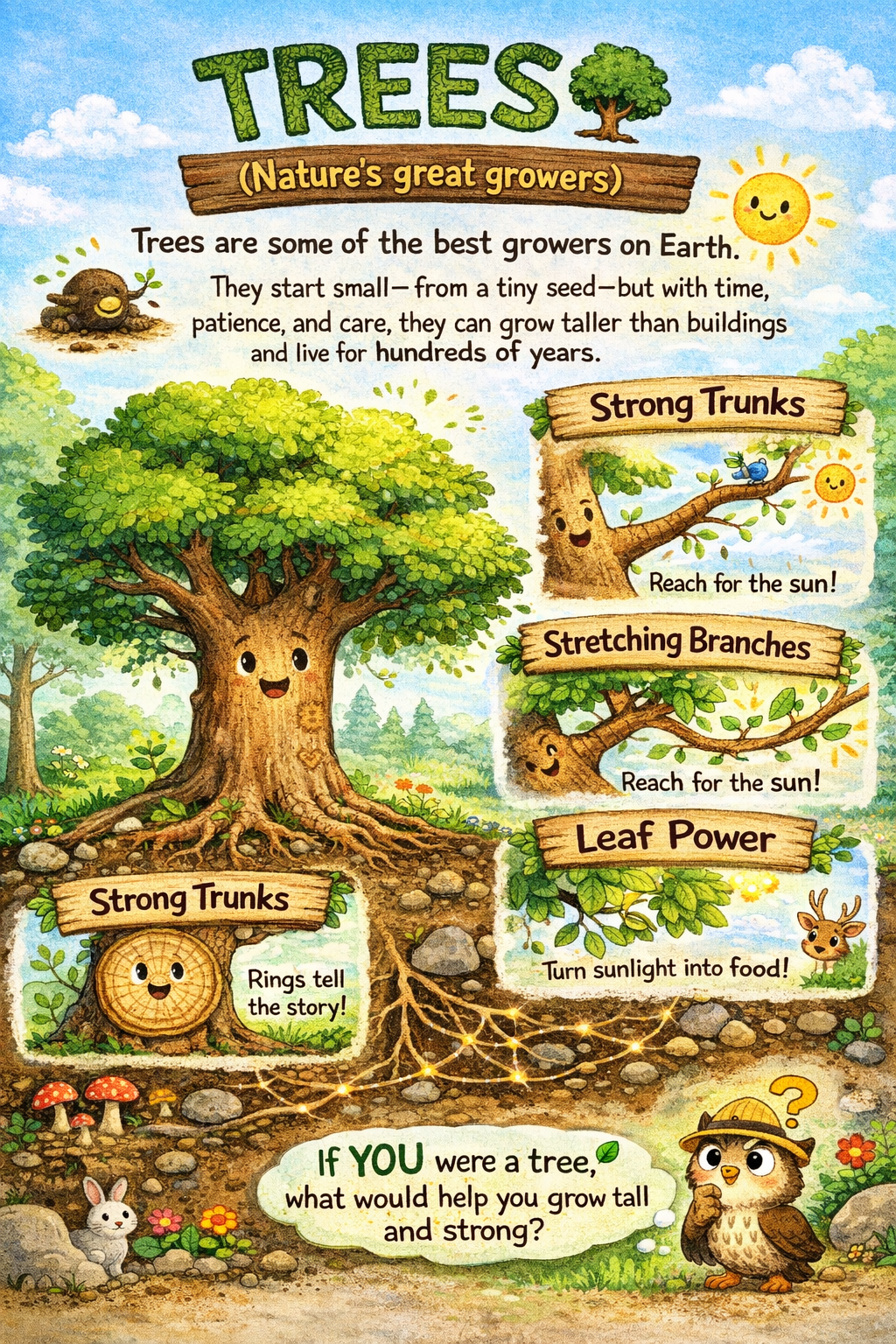
(Nature’s great growers)
Trees are some of the best growers on Earth.
They start small—from a tiny seed—but with time, patience, and care, they can grow taller than buildings and live for hundreds of years.
A tree’s trunk is its backbone. It holds the tree upright and carries water and nutrients from the roots to the leaves. As the tree grows, the trunk grows stronger, adding rings each year that tell the story of its life—good seasons, hard seasons, and everything in between.
Branches reach outward and upward, searching for sunlight. Leaves collect energy from the sun and turn it into food, helping the whole tree grow. Every part works together—roots, trunk, branches, and leaves—to keep the tree healthy.
Trees are also great sharers. They give us shade, clean air, homes for animals, and beauty for the world. Some trees even communicate with each other through their roots, warning nearby trees of danger.
Trees remind us that growth takes time. With strong roots, steady learning, and room to reach, amazing things can happen.
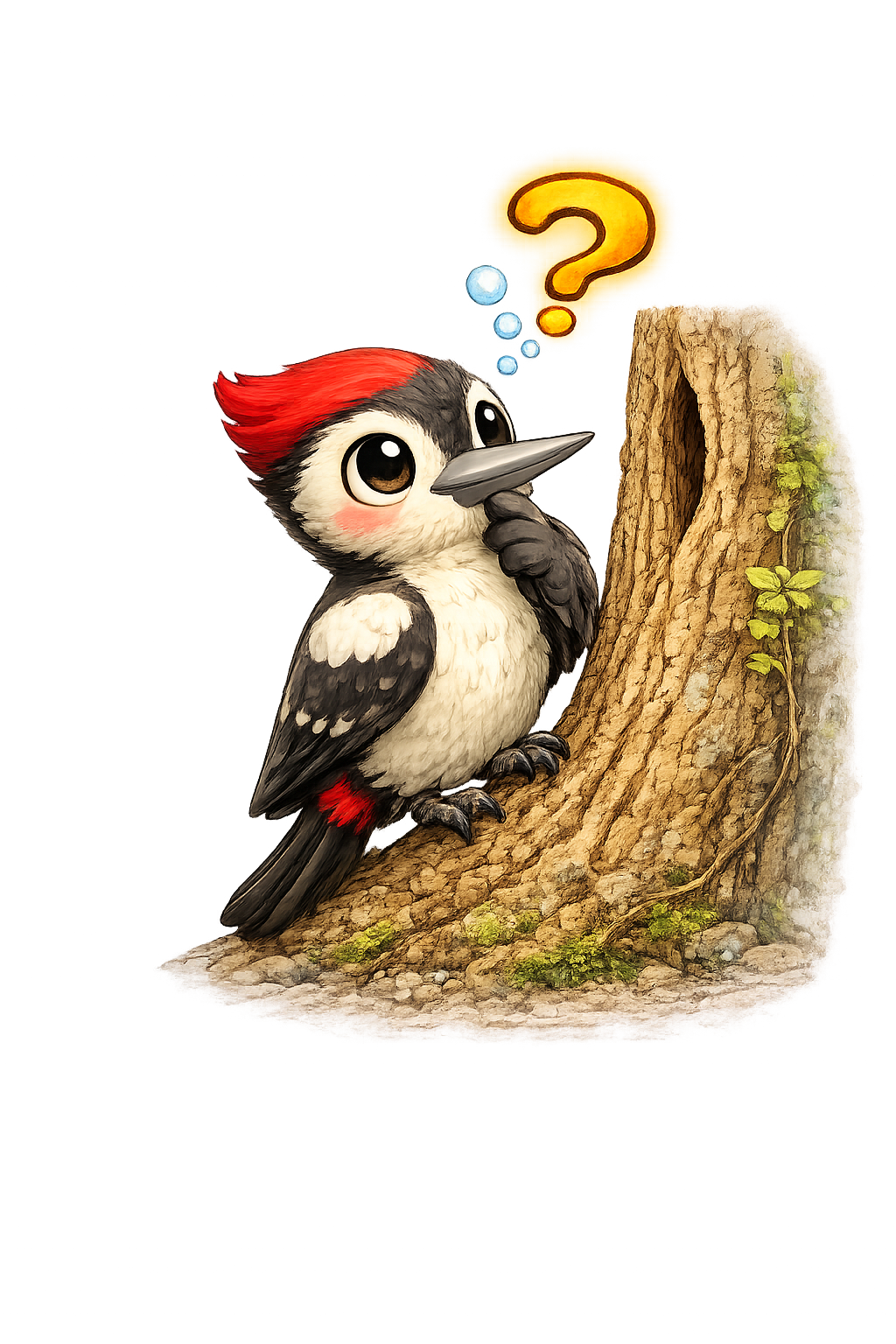
Quick Think
If you were a tree, what would help you grow tall and strong?
SEEDS
(Tiny beginnings, big possibilities)
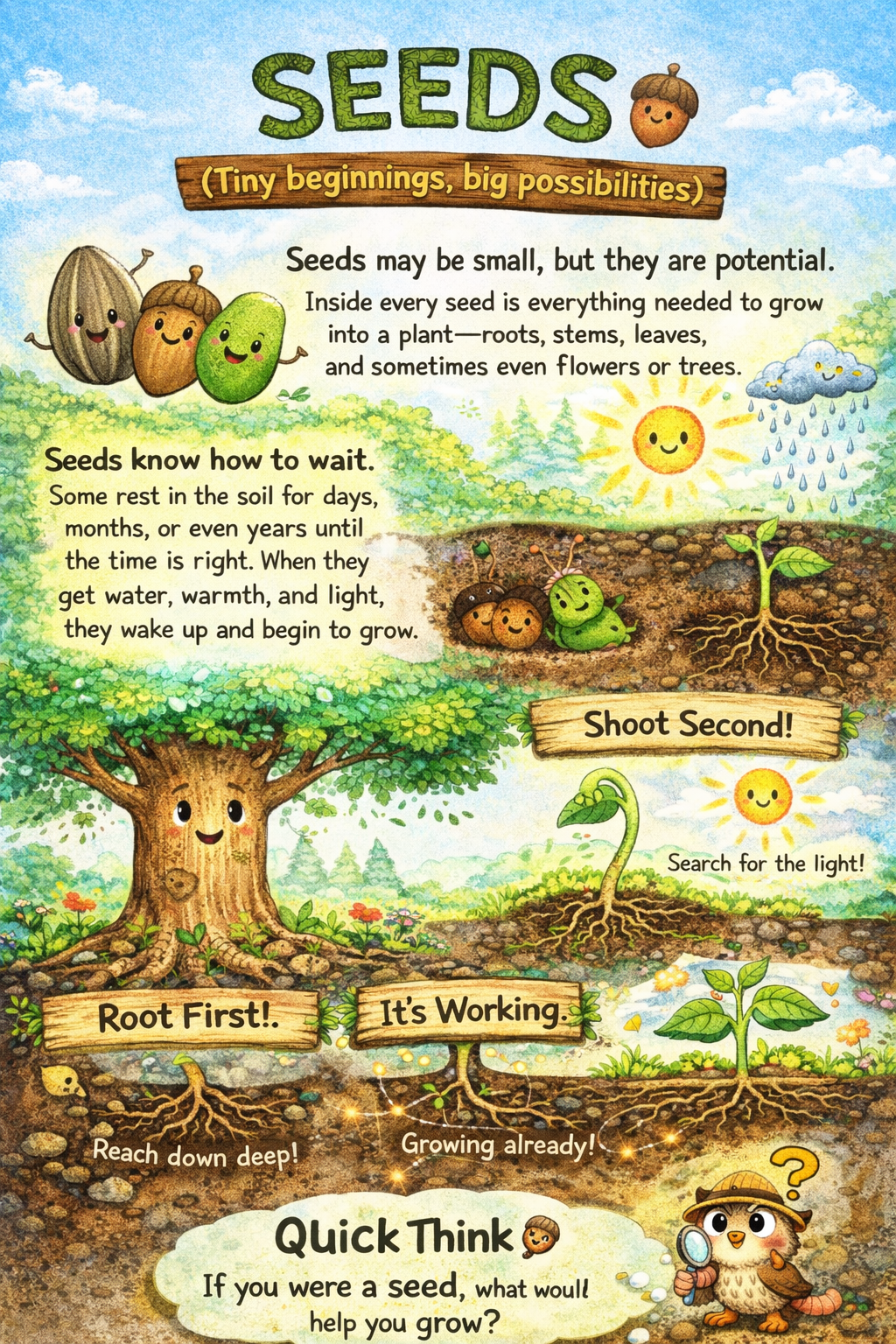
Seeds may be small, but they are full of potential.
Inside every seed is everything needed to grow into a plant—roots, stems, leaves, and sometimes even flowers or trees.
Seeds know how to wait. Some rest in the soil for days, months, or even years until the time is right. When they get water, warmth, and light, they wake up and begin to grow.
The first thing a seed sends out is a root. That root reaches down to find water and hold the plant steady. Then a shoot grows upward, searching for light. Even before we can see it, the seed is already hard at work.
Seeds remind us that big things often start small. With patience, care, and the right conditions, something tiny can grow into something strong, tall, and full of life.
Quick Think
If you were a seed, what would help you grow?
MOSS
(Small, soft, and quietly strong)
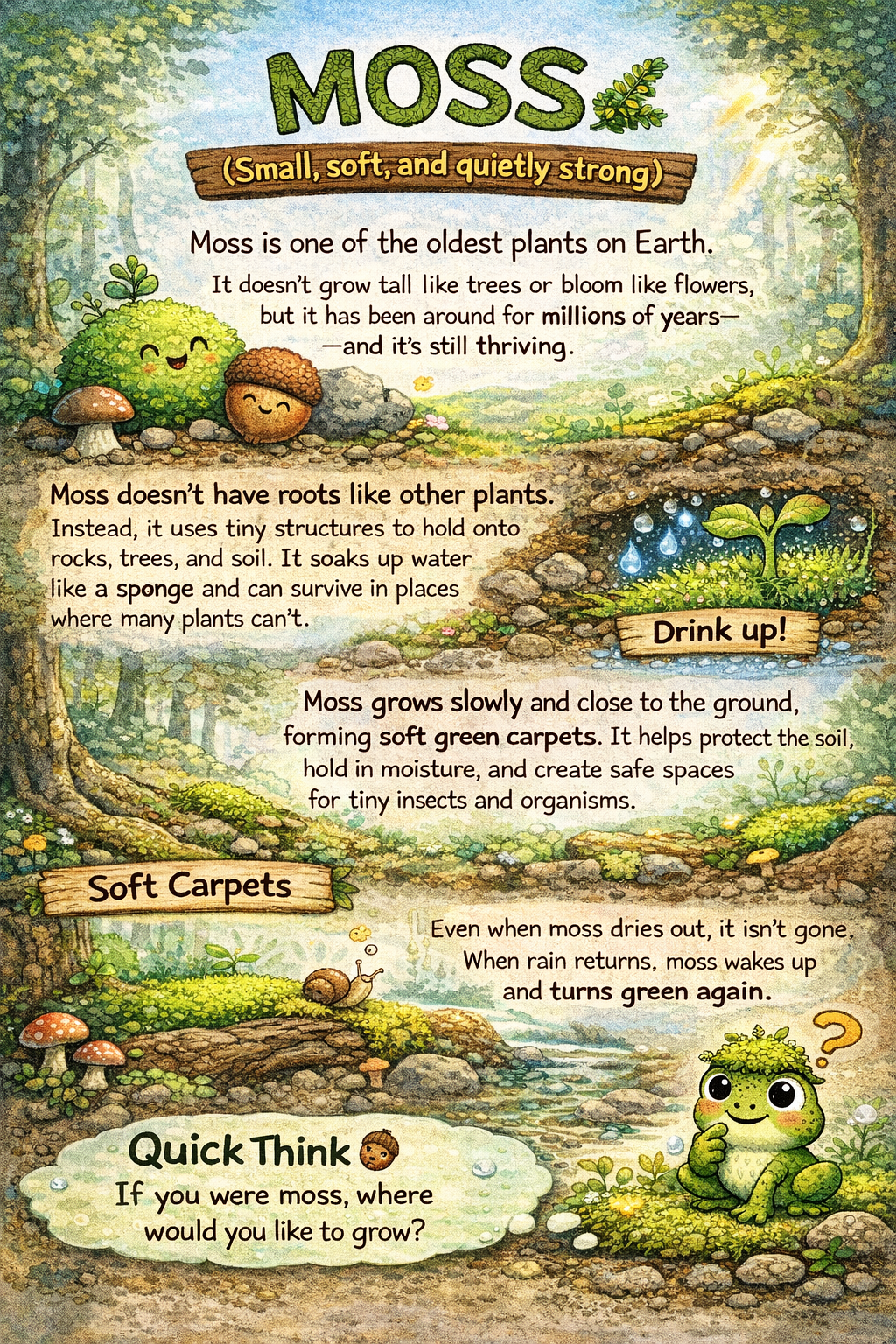
Moss is one of the oldest plants on Earth.
It doesn’t grow tall like trees or bloom like flowers, but it has been around for millions of years—and it’s still thriving.
Moss doesn’t have roots like other plants. Instead, it uses tiny structures to hold onto rocks, trees, and soil. It soaks up water like a sponge and can survive in places where many plants can’t.
Moss grows slowly and close to the ground, forming soft green carpets. It helps protect the soil, hold in moisture, and create safe spaces for tiny insects and organisms.
Even when moss dries out, it isn’t gone. When rain returns, moss wakes up and turns green again. It knows how to pause, wait, and begin once more.
Moss reminds us that growth doesn’t have to be fast or tall to be powerful. Sometimes, growing quietly and steadily is exactly enough.
Quick Think
If you were moss, where would you like to grow?
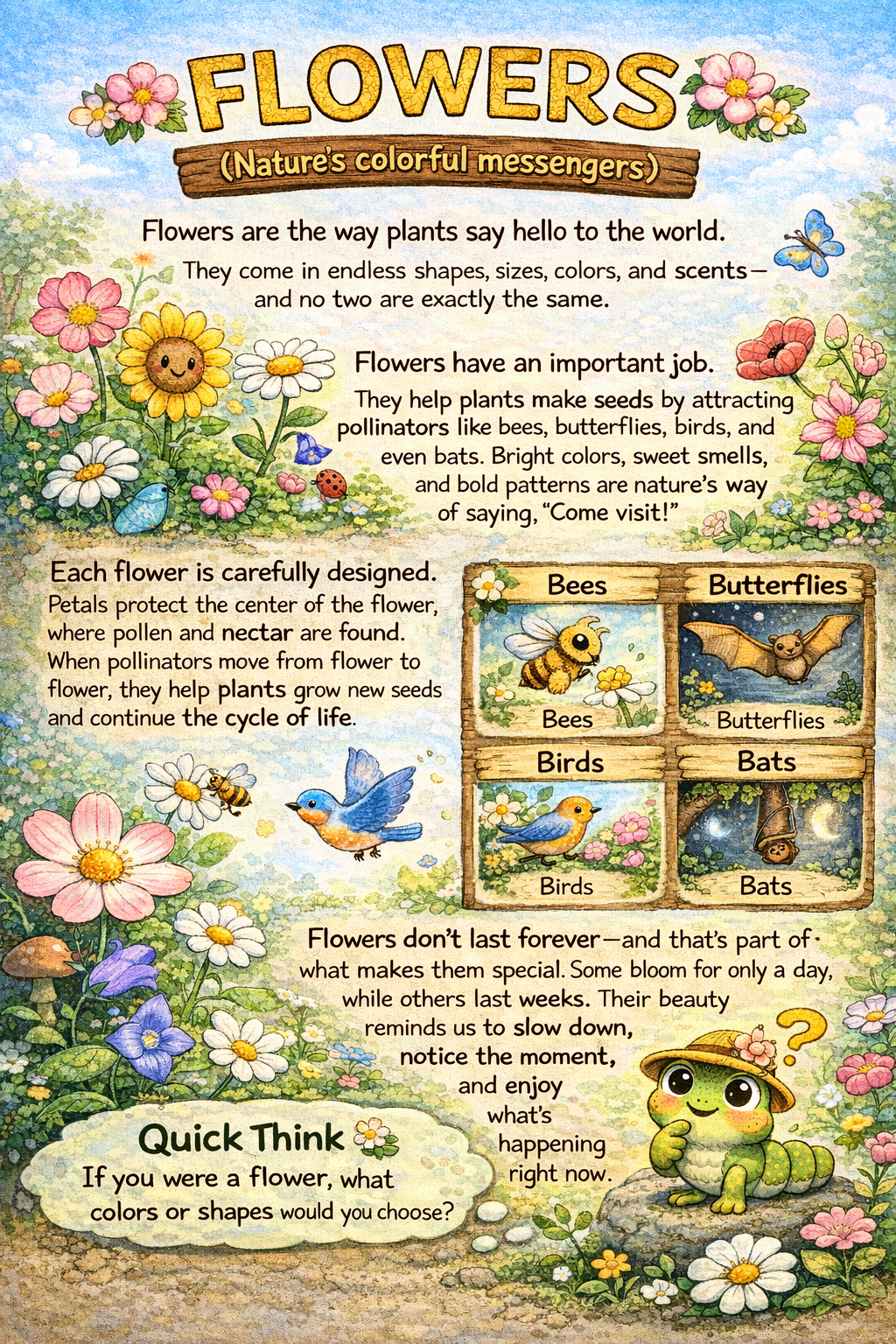
FLOWERS
(Nature’s colorful messengers)
Flowers are the way plants say hello to the world.
They come in endless shapes, sizes, colors, and scents—and no two are exactly the same.
Flowers have an important job. They help plants make seeds by attracting pollinators like bees, butterflies, birds, and even bats. Bright colors, sweet smells, and bold patterns are nature’s way of saying, “Come visit!”
Each flower is carefully designed. Petals protect the center of the flower, where pollen and nectar are found. When pollinators move from flower to flower, they help plants grow new seeds and continue the cycle of life.
Flowers don’t last forever—and that’s part of what makes them special. Some bloom for only a day, while others last weeks. Their beauty reminds us to slow down, notice the moment, and enjoy what’s happening right now.
Flowers show us that growth can be joyful, expressive, and shared. After growing deep and strong, this is how plants celebrate.
Quick Think
If you were a flower, what colors or shapes would you choose
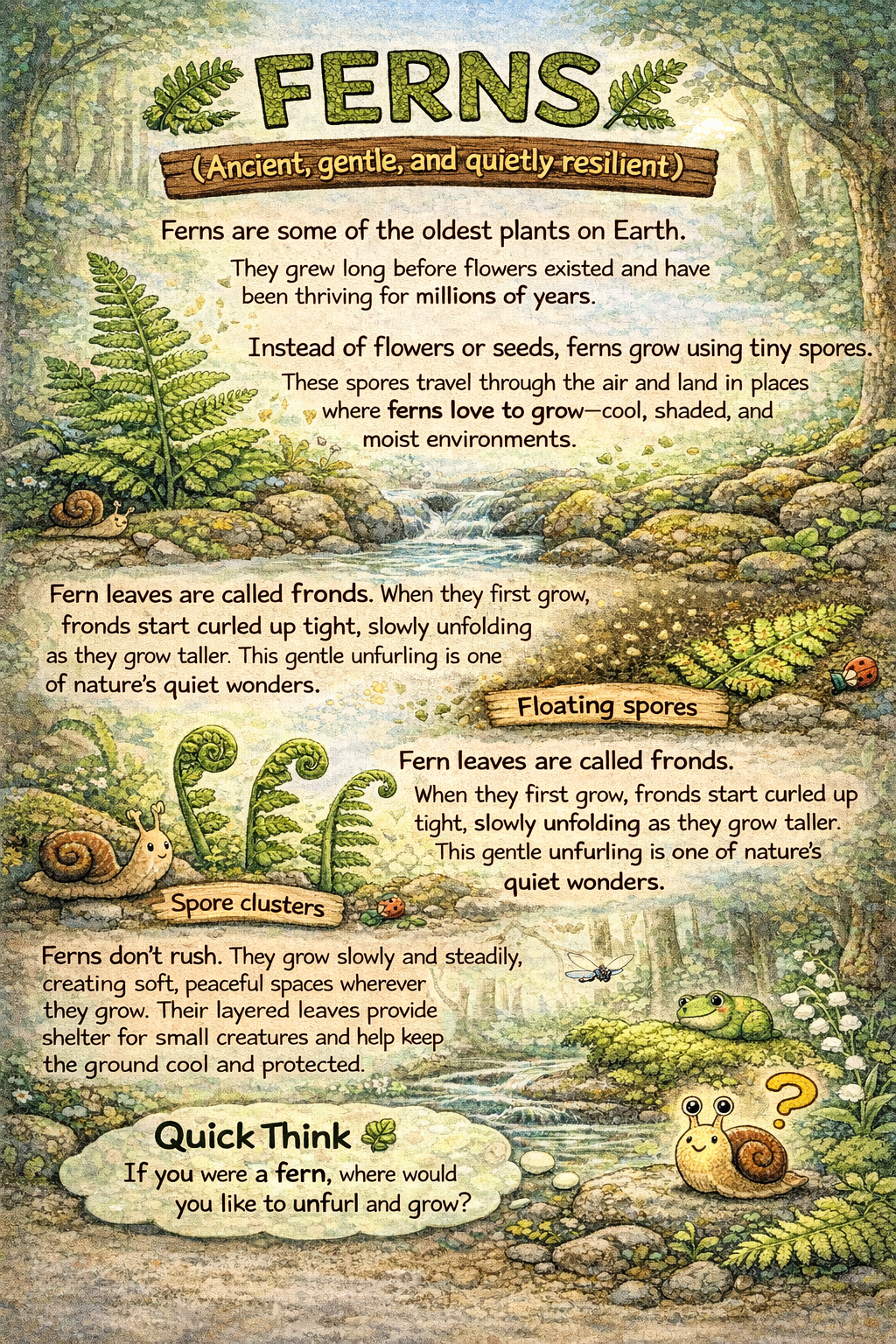
FERNS
(Ancient, gentle, and quietly resilient)
Ferns are some of the oldest plants on Earth.
They grew long before flowers existed and have been thriving for millions of years.
Instead of flowers or seeds, ferns grow using tiny spores. These spores travel through the air and land in places where ferns love to grow—cool, shaded, and moist environments.
Fern leaves are called fronds. When they first grow, fronds start curled up tight, slowly unfolding as they grow taller. This gentle unfurling is one of nature’s quiet wonders.
Ferns don’t rush. They grow slowly and steadily, creating soft, peaceful spaces wherever they grow. Their layered leaves provide shelter for small creatures and help keep the ground cool and protected.
Ferns remind us that growth doesn’t always need attention or applause. Some of the strongest growth happens quietly, with patience and care.
Quick Think
If you were a fern, where would you like to unfurl and grow?
POLLINATORS
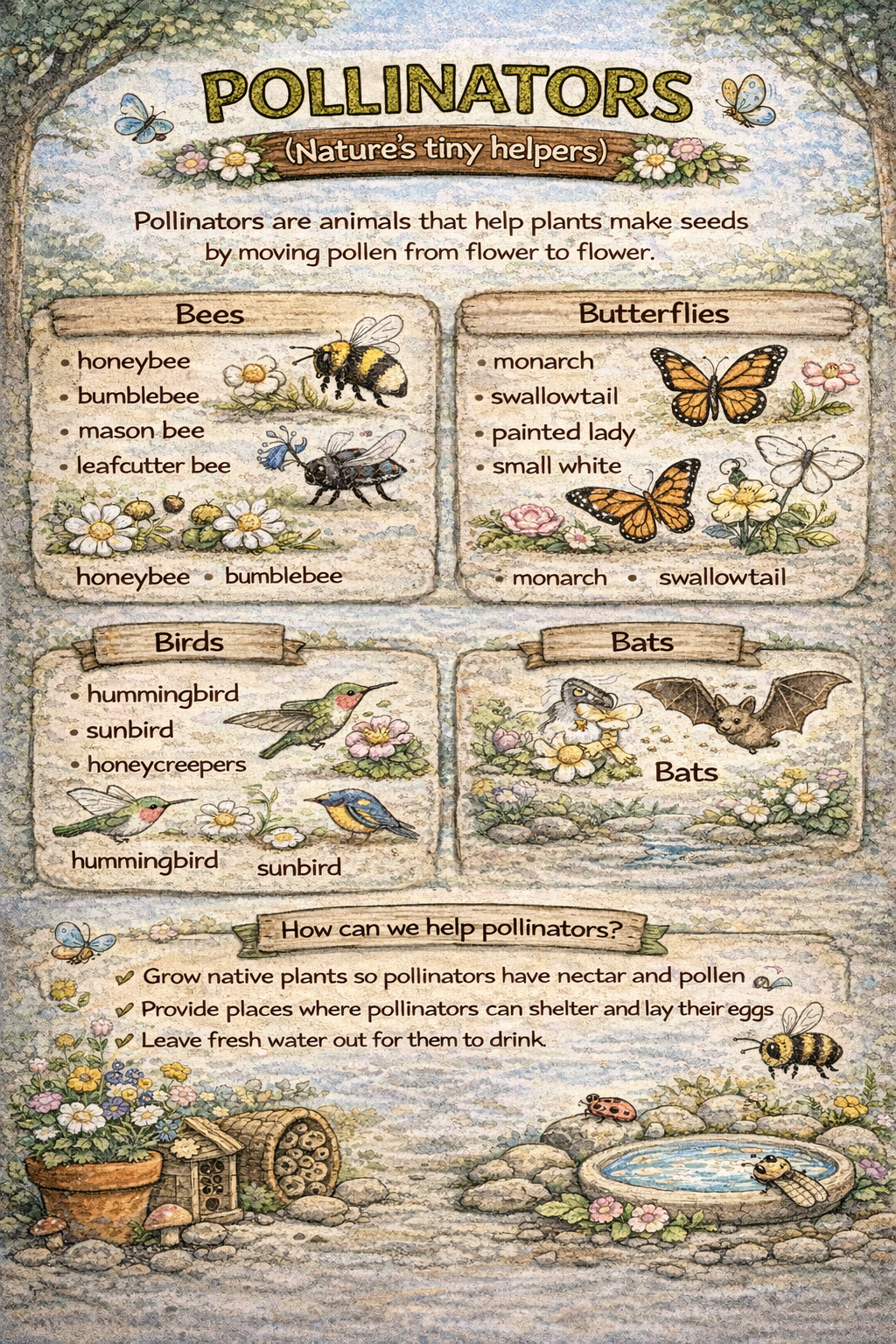
(Nature’s tiny helpers)
Pollinators are some of the hardest workers in nature.
They may be small, but they do a very big job.
Bees, butterflies, birds, bats, and even some beetles are pollinators. As they move from flower to flower looking for nectar, they carry pollen with them. This pollen helps plants make seeds, fruits, and new plants. Without pollinators, many of the foods we eat—like apples, strawberries, and almonds—would not grow.
Pollinators and plants work as a team. Flowers use bright colors and sweet smells to attract pollinators. In return, pollinators get food. This teamwork helps gardens, farms, and wild places stay healthy.
Pollinators help more than plants. When plants grow well, animals have food and shelter, and people have food to eat. Pollinators help keep the whole ecosystem balanced.
Pollinators remind us that even small actions matter. By doing their job a little at a time, they help the world bloom.
Quick Think
If you were a pollinator, how would you help the world grow?
HERITAGE
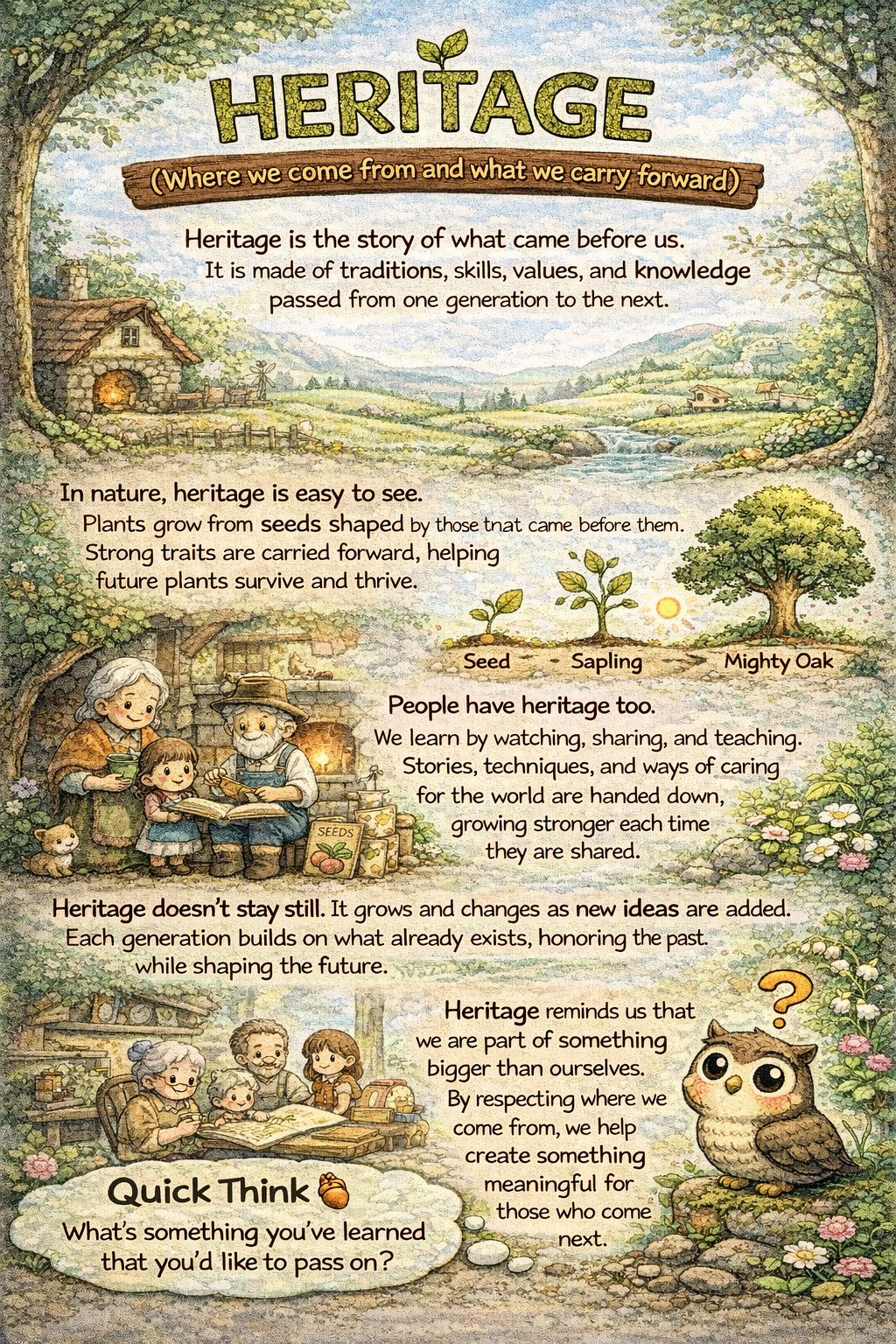
(Where we come from and what we carry forward)
Heritage is the story of what came before us.
It is made of traditions, skills, values, and knowledge passed from one generation to the next.
In nature, heritage is easy to see. Plants grow from seeds shaped by those that came before them. Strong traits are carried forward, helping future plants survive and thrive.
People have heritage too. We learn by watching, sharing, and teaching. Stories, techniques, and ways of caring for the world are handed down, growing stronger each time they are shared.
Heritage doesn’t stay still. It grows and changes as new ideas are added. Each generation builds on what already exists, honoring the past while shaping the future.
Heritage reminds us that we are part of something bigger than ourselves. By respecting where we come from, we help create something meaningful for those who come next.
Quick Think
What’s something you’ve learned that you’d like to pass on?
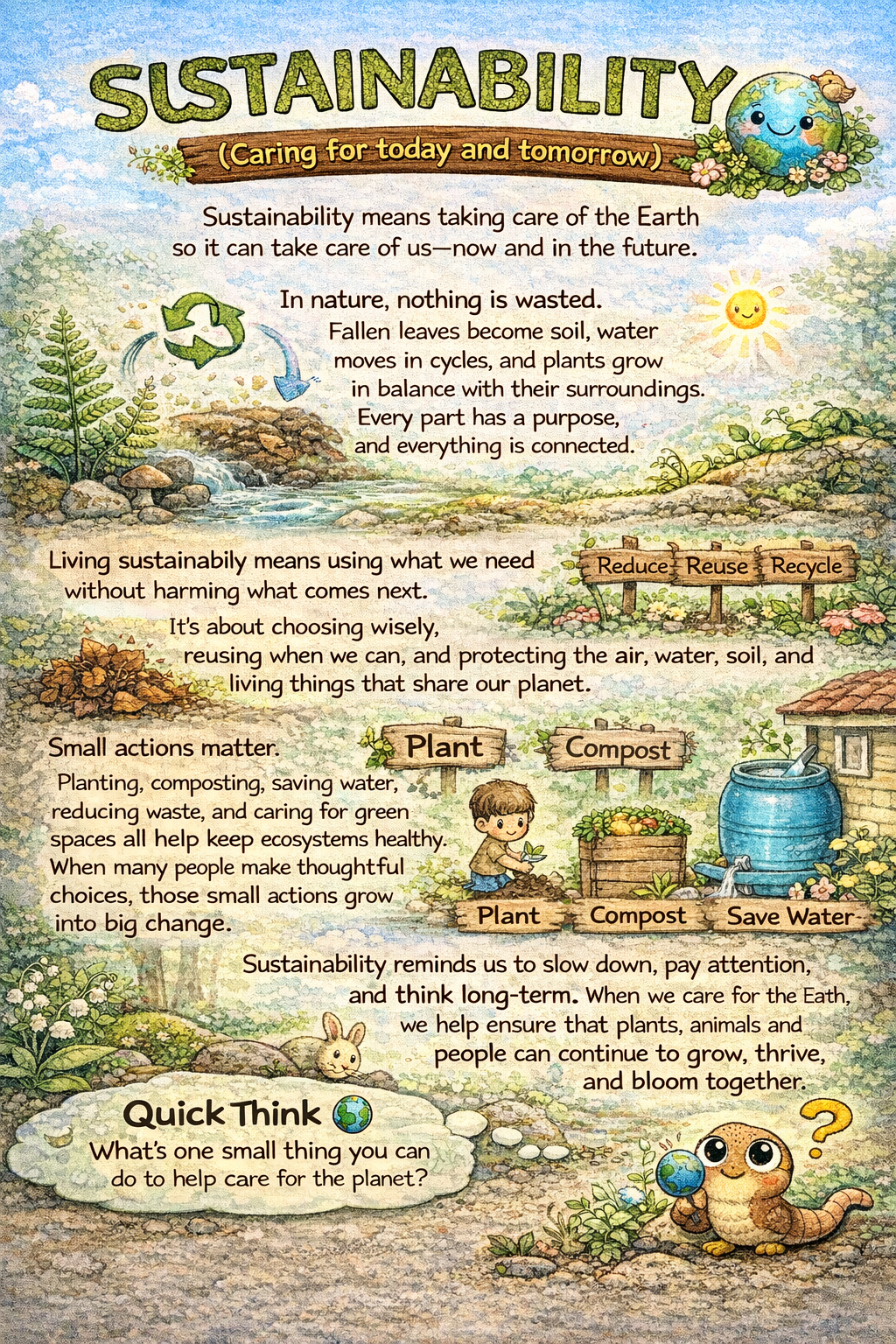
SUSTAINABILITY
(Caring for today and tomorrow)
Sustainability means taking care of the Earth so it can take care of us—now and in the future.
In nature, nothing is wasted. Fallen leaves become soil, water moves in cycles, and plants grow in balance with their surroundings. Every part has a purpose, and everything is connected.
Living sustainably means using what we need without harming what comes next. It’s about choosing wisely, reusing when we can, and protecting the air, water, soil, and living things that share our planet.
Small actions matter. Planting, composting, saving water, reducing waste, and caring for green spaces all help keep ecosystems healthy. When many people make thoughtful choices, those small actions grow into big change.
Sustainability reminds us to slow down, pay attention, and think long-term. When we care for the Earth, we help ensure that plants, animals, and people can continue to grow, thrive, and bloom together.
Quick Think
What’s one small thing you can do to help care for the planet?
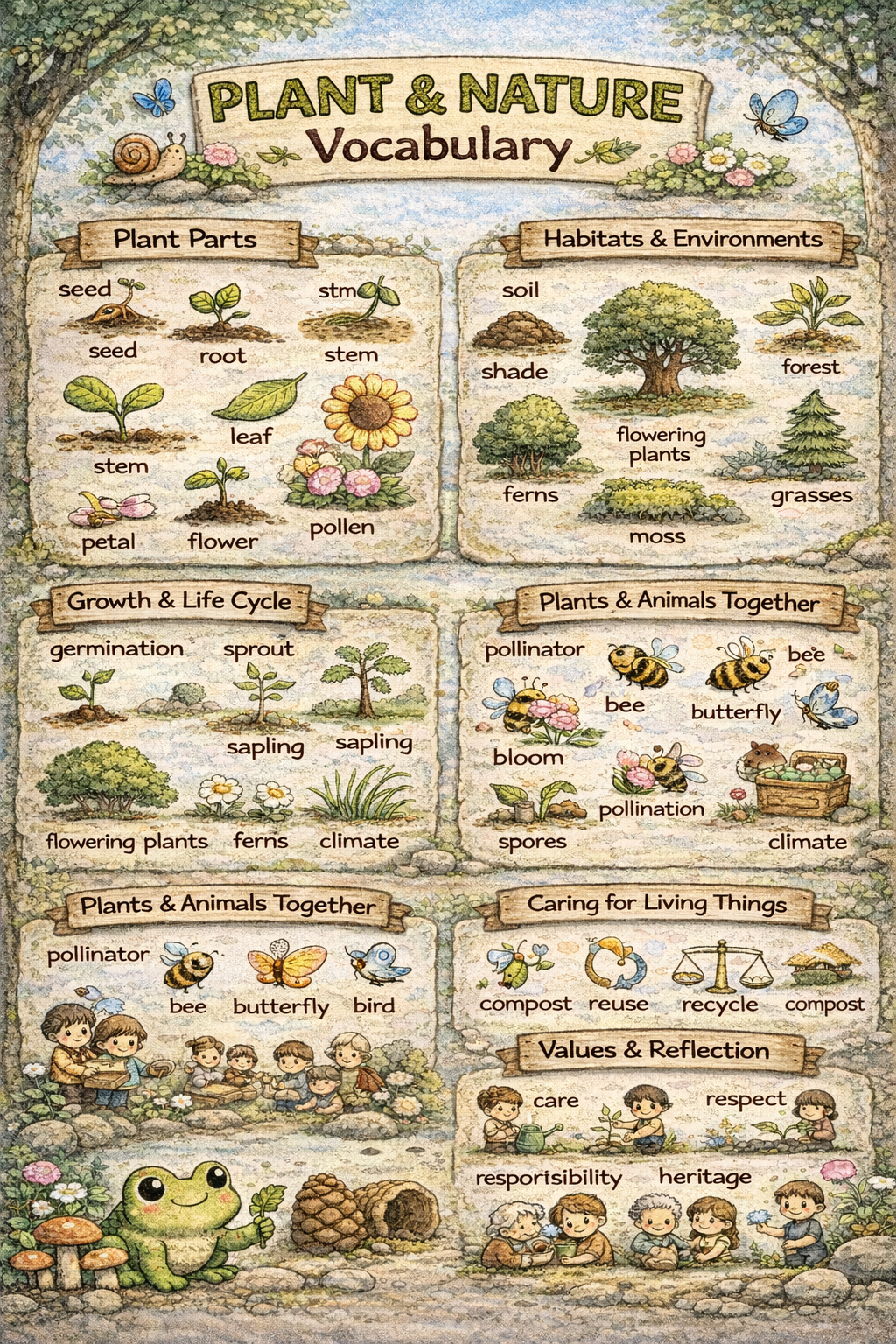
PLANT & NATURE WORDS
(The language of the living world)
Plants and nature have their own special language.
These words help us understand how living things grow, change, and work together.
Words like root, stem, and leaf tell us about the parts of a plant. Each part has an important job. Roots anchor plants in the soil and take in water. Stems hold plants up and move nutrients. Leaves capture sunlight to make food.
Nature words also describe processes. Germination is when a seed begins to grow. Photosynthesis is how plants use sunlight, air, and water to make energy. Pollination is how plants make seeds with help from animals or the wind. These words explain the invisible work happening all around us.
Some words describe relationships in nature. Habitat means a place where a plant or animal lives. Ecosystem describes how living and non-living things depend on one another. Biodiversity means the variety of life in an area, and it helps nature stay strong and balanced.
Learning plant and nature vocabulary helps us notice more. When we know the words, we can see patterns, ask questions, and better understand the world outside our door.
Words help us grow our knowledge—just like water helps plants grow..
Quick Think
Which nature word do you like most, and what does it help you understand?